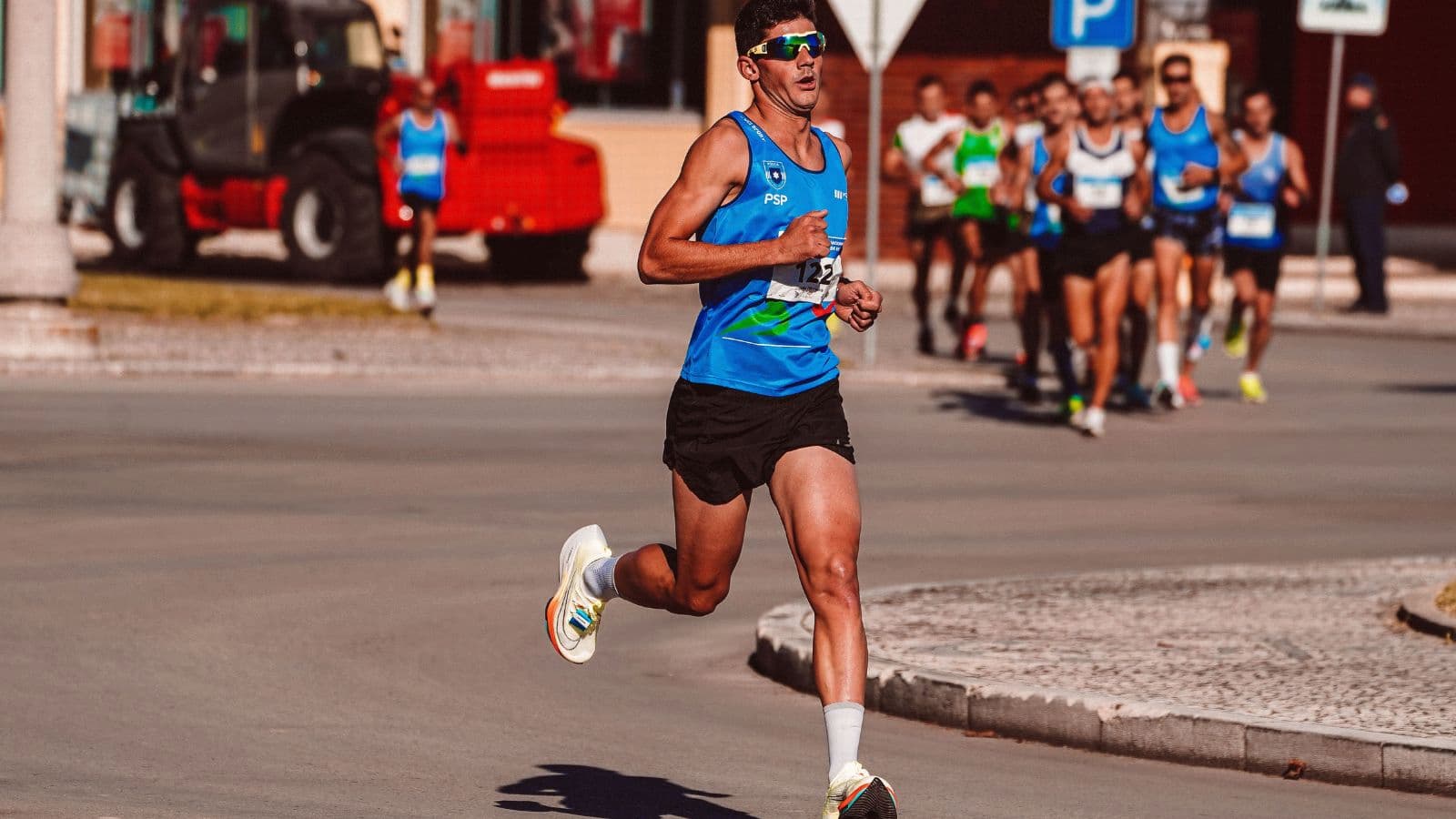
Elbow position might seem like a small detail in running technique, but it influences how your entire upper body moves. Your arms help counterbalance the movement of your legs, contribute to rhythm and help keep your body stable as speed, terrain and fatigue change. There isn’t one exact elbow angle every runner needs to maintain. Instead, the goal is a comfortable bend that allows your shoulders, hands and arms to remain relaxed while the arms swing naturally forward and backward. Improving elbow position should therefore be about encouraging relaxed, economical movement, not forcing your arms into a perfect-looking position.
In Short
- Keep your elbows comfortably bent.
- Avoid forcing one exact elbow angle.
- Let your arms swing naturally.
- Keep unnecessary shoulder tension low.
- Limit excessive movement across your torso.
Why Do Your Arms Matter When Running?
Running isn’t performed only by your legs. As one leg moves forward, the opposite arm naturally moves forward to help counterbalance rotational forces created by the lower body.
Your arms therefore contribute to:
- Balance.
- Rhythm.
- Coordination.
- Upper-body stability.
Efficient arm movement supports the overall running pattern rather than acting as a separate technique. Understanding how do arm swings improve running form provides useful context for why elbow position matters within the complete arm movement.
What Should Your Elbow Position Look Like?
For most runners, the elbows remain comfortably bent while running.
Rather than trying to maintain an exact angle, focus on whether the position feels:
- Natural.
- Relaxed.
- Sustainable.
- Free of unnecessary tension.
Your elbow angle can change slightly throughout the arm swing and may also change as your running speed increases. Trying to lock the elbow into one exact position can make your movement more rigid rather than more efficient.
Why a Relaxed Bend Works
Keeping some bend in the elbow creates a compact arm swing. If your arms become excessively straight, they create a longer lever that may require more effort to move. A comfortable bend allows the arms to swing rhythmically without exaggerated movement. The important word is comfortable. Forcing a very tight bend can create just as much unnecessary tension as running with overly straight arms.
Your Arms Should Move Mostly Forward and Backward
Efficient arm swing generally occurs predominantly in the direction you’re travelling. Excessive side-to-side movement can increase unnecessary upper-body rotation.
Watch for:
- Hands repeatedly crossing the body’s midline.
- Elbows flaring dramatically outward.
- Excessive torso rotation.
- Shoulders twisting with every stride.
Some natural rotation is expected. The goal isn’t to eliminate movement but to avoid exaggerated motion that doesn’t contribute to forward running.
Elbow Position Can Influence Your Shoulders
Elbow position and shoulder tension are closely connected. When runners consciously hold their arms too rigidly, they often raise or tighten their shoulders.
That tension can spread into the:
- Neck.
- Upper back.
- Hands.
- Forearms.
During easy runs, occasionally check whether your shoulders feel relaxed. Working on how does posture affect running performance can help you understand how arm position fits within overall upper-body alignment.
Don’t Clench Your Hands
Hand tension often travels upward through the arms. If you’re squeezing your fists tightly, your forearms, elbows and shoulders may also become unnecessarily tense.
Instead:
- Keep your hands relaxed.
- Avoid squeezing your fingers.
- Let the wrists remain neutral.
- Periodically shake out tension if necessary.
Relaxation is usually more useful than trying to consciously control every centimetre of your arm movement.
Elbow Position Changes With Running Speed
Your arm swing doesn’t need to look identical at every pace. During easy running, the movement may be relatively small and relaxed.
As you accelerate:
- Arm drive may become stronger.
- The swing may become quicker.
- Elbow movement may increase.
- The arms help match the faster leg rhythm.
Allow these changes to happen naturally rather than deliberately exaggerating them. Runners trying to become faster can use how to increase running speed (without overtraining) to develop speed through appropriate training rather than trying to manufacture it purely through aggressive arm movement.
Arm Swing Helps Maintain Running Rhythm
Your arms and legs naturally coordinate with each other. When fatigue develops, maintaining a relaxed arm rhythm can sometimes help you preserve overall running coordination.
This can become particularly useful:
- Late in races.
- During hills.
- When accelerating.
- When running over uneven terrain.
However, actively pumping the arms harder isn’t automatically more efficient. The movement still needs to remain controlled.
Elbow Position Matters on Hills
Climbing changes running mechanics. Your stride often becomes shorter, cadence may change and arm action can become more pronounced.
On climbs:
- Keep your elbows comfortably bent.
- Allow slightly stronger arm movement.
- Keep your shoulders relaxed.
- Avoid excessive side-to-side rotation.
Hill running naturally encourages more active arm use, particularly on steeper gradients. Understanding how does hill running improve fitness, strength, and endurance can help you incorporate climbing without treating every hill as a technical arm-swing drill.
What Happens When Your Arms Cross Your Body?
Some runners naturally allow their hands to move slightly inward, which isn’t automatically a problem. The issue is excessive crossover. A large cross-body swing may contribute to unnecessary torso rotation and make your running movement less economical. Instead of forcing your hands completely straight, think about allowing the arms to move comfortably in the general direction of travel.
What About Elbows That Flare Out?
Some runners carry their elbows noticeably away from their torso. This isn’t necessarily harmful, particularly if the runner is comfortable and efficient. However, dramatic flaring combined with shoulder tension or excessive torso rotation may indicate that you’re carrying unnecessary upper-body tension.
Before trying to change your elbow position, first ask whether it is actually causing a problem.
Fatigue Can Change Arm Position
Running form naturally changes as you become tired.
Late in a long run, you might notice:
- Lower hands.
- Wider elbows.
- Increased shoulder tension.
- Greater torso rotation.
- Less coordinated arm movement.
Rather than obsessing over elbow angle, use these changes as a reminder to relax and reassess your overall form. Building endurance through how to run longer distances without burning out can also help you maintain efficient movement later in longer sessions.
Stronger Upper-Body Stability Can Help
Arm movement doesn’t happen independently from your trunk. Good core and upper-body stability help you control rotation while your arms and legs move.
Runners don’t need large amounts of upper-body muscle, but appropriate strength training can support:
- Posture.
- Stability.
- Coordination.
- Fatigue resistance.
Following what strength routine should runners do to stay injury-free can complement technique work without making arm position the sole focus.
Should You Practise Arm-Swing Drills?
Simple drills can help if you have a clear problem with your arm movement.
One option is to practise standing arm swings:
- Stand tall.
- Bend your elbows comfortably.
- Relax your hands.
- Move the arms forward and backward.
- Keep your shoulders relaxed.
- Gradually increase the rhythm.
Then reproduce the same relaxed sensation during an easy run. Drills should help you feel smoother movement rather than create another technical rule you need to constantly think about.
Video Can Help Identify Problems
What you think your arms are doing and what they’re actually doing can be different.
A short running video from the front and side may reveal:
- Excessive crossover.
- Shoulder elevation.
- Uneven arm movement.
- Unnecessary tension.
However, don’t assume every asymmetry needs correcting. Human running movement isn’t perfectly symmetrical.
Don’t Overthink Your Running Form
Trying to consciously control your:
- Elbows.
- Hands.
- Shoulders.
- Foot strike.
- Cadence.
- Posture.
all at once can make running feel unnatural. Make one small adjustment at a time and judge whether it actually improves comfort or efficiency. This is exactly why how to improve your running form without overthinking it is useful when making technical changes.
Running Cadence and Arm Rhythm Work Together
Your arms typically move in rhythm with your legs. As cadence increases, arm movement generally becomes quicker as well. You don’t necessarily need to consciously speed up your arms to change cadence, but keeping them relaxed can support natural coordination. Understanding how does increasing running cadence help prevent knee injuries also provides wider context for how cadence changes interact with overall running mechanics.
When Should You Seek Professional Advice?
Consider having your running form assessed if you experience:
- Persistent pain.
- Significant asymmetry.
- Previous upper-body injury.
- Repeated discomfort while running.
- A major change in your normal movement.
A physiotherapist, sports clinician or qualified running professional can determine whether your arm position is actually contributing to the problem.
Common Mistakes
- Locking the elbows at one angle.
- Clenching the fists.
- Raising the shoulders.
- Swinging excessively across the body.
- Forcing an exaggerated arm drive.
- Changing natural movement without a reason.
- Focusing on elbows while ignoring posture.
- Trying to correct several form issues simultaneously.
Practical Tips
- Keep your elbows comfortably bent.
- Relax your hands and shoulders.
- Let your arms swing naturally.
- Avoid excessive crossover.
- Allow arm action to change with speed.
- Check your form when fatigue develops.
- Use video if you suspect a problem.
- Make small technical changes gradually.
Actionable Takeaways
Elbow position affects running form primarily through its influence on arm swing, relaxation and upper-body movement. Rather than trying to hold your elbows at one perfect angle, aim for a comfortable bend that allows your arms to move naturally with your stride.
Keep your shoulders and hands relaxed, avoid excessive cross-body swinging and allow your arm action to adapt naturally as speed and terrain change. Efficient running form rarely comes from forcing your body into rigid positions; it comes from coordinated, comfortable movement that you can maintain as fatigue develops.
FAQs
There isn’t one perfect position for every runner. Your elbows should generally remain comfortably bent in a way that allows relaxed, natural arm movement.
Not necessarily. Your elbow angle naturally changes during the arm swing, so there is no need to rigidly maintain exactly 90 degrees.
They should generally move predominantly forward and backward, although some natural rotational movement is normal.
A small amount of inward movement isn’t necessarily problematic. Excessive crossover may create unnecessary upper-body rotation.
It may simply be your natural movement pattern, although shoulder tension, posture or running fatigue can sometimes contribute.
Your arm movement naturally becomes more active as speed increases, but deliberately exaggerating your arm drive isn’t necessary for most runners.
Excessive tension or unnecessary movement may contribute to inefficient running, although arm swing is only one part of overall running mechanics.
Fatigue, clenched hands, forced arm positioning and general upper-body tension can all contribute to tight shoulders.
Yes. Arm action often becomes stronger during climbing as stride mechanics and effort change.
Start by relaxing your hands and shoulders, keep the elbows comfortably bent and practice allowing your arms to swing naturally rather than forcing a specific angle.