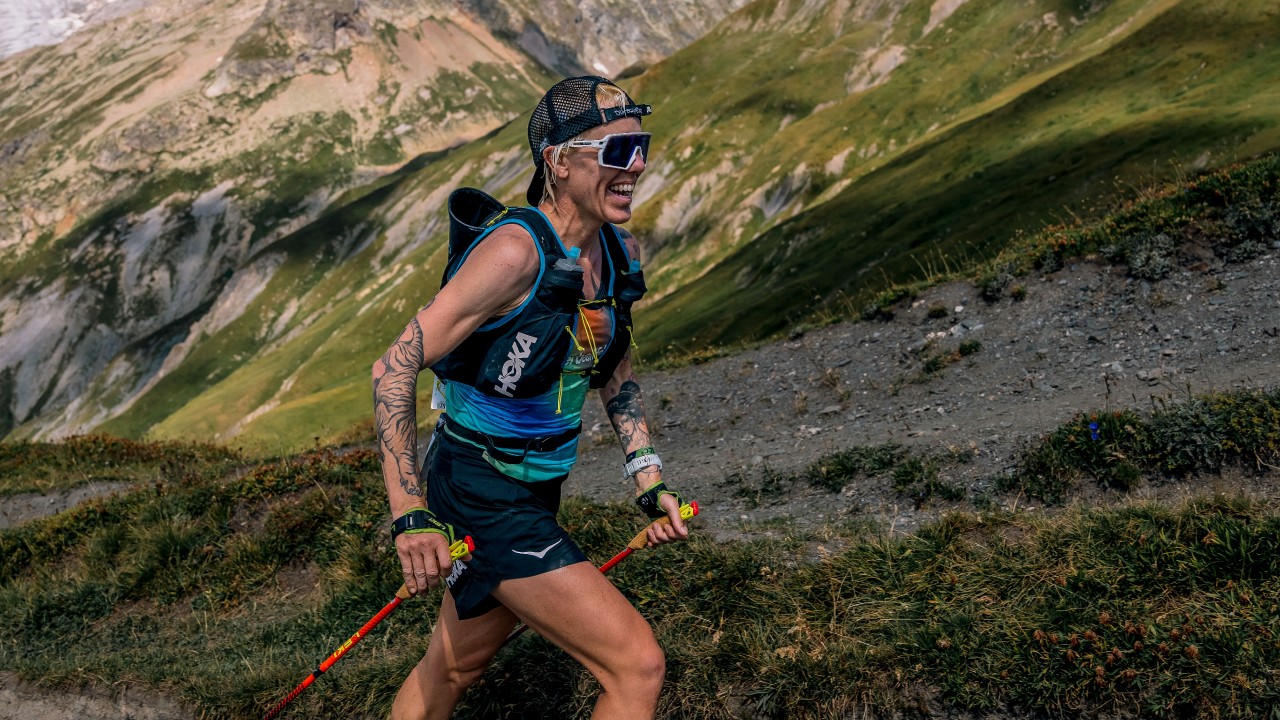


There are dominant ultramarathon victories. And then there is what Rachel Entrekin did at the 2026 Cocodona 250.
Not only did the American claim a third consecutive title in the brutal 250-mile Arizona trail race, she became the first woman ever to win the event outright – beating the entire field, men and women alike – while smashing the course record with a staggering time of 56:09:48.
The scale of that achievement is difficult enough to comprehend on its own. But the deeper you dive into the data behind Entrekin’s performance, the more remarkable it becomes.
Because this was not simply an athlete surviving one of the toughest races on the planet. This was an athlete engineering a performance.
Every major element had been refined: the pacing, the recovery, the downhill running, the carb-loading, the sodium strategy, the caffeine intake, the gut training and even the sleep deprivation.
And perhaps the most astonishing detail of all? Before the race, Entrekin’s own calculations suggested breaking 60 hours might not even be possible.
We have delved into the data provided by both COROS – in terms of her pre-race training and heart rate monitor figures – as well as Precision Fuel & Hydration.
Chasing the impossible
Entrekin arrived at Cocodona with an intimate understanding of the course after winning the previous two editions.
In 2024 she claimed victory in 73:31:25. In 2025 she returned to lower the women’s course record to 63:50:55. But for 2026, the ambition changed completely.
This time, the goal was sub-60 hours.
To get there, Entrekin leaned into a level of planning she openly admits does not come naturally to her.
Spreadsheets became unavoidable.
Using previous splits and projected pacing, she repeatedly tried to model a route to the barrier. Each time she arrived at essentially the same answer.
61 hours and 50 minutes.
On paper, even the best-case scenario seemed to fall short.
But Cocodona is not raced on paper.
Training to race, not survive
The most fascinating aspect of Entrekin’s preparation may be how different it looked from traditional ultramarathon training philosophy.
Between December 1, 2025 and May 1, 2026, data from COROS showed Entrekin accumulated 1,711.63 miles across 329 hours, 18 minutes and 25 seconds of training.
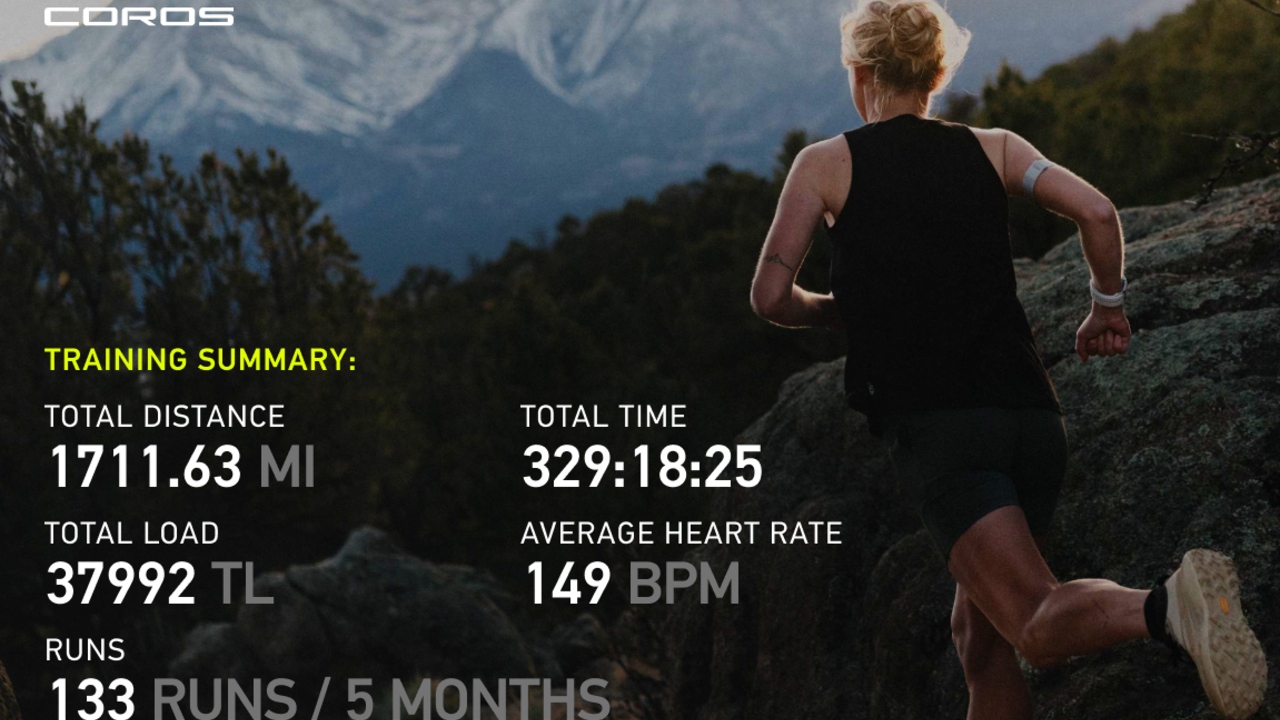
That equates to an average of 77.8 miles and just under 15 hours of activity per week.
Huge numbers by normal standards. But perhaps surprisingly restrained compared to many elite ultrarunners preparing for a 250-mile event.
What stands out more is how Entrekin distributed the work.
Rather than relentless daily volume, many weeks featured only four to five sessions, often interspersed with deliberate recovery days. Big back-to-back efforts were followed by periods designed specifically to absorb the load.
The approach was highly intentional.
She was not trying to simply accumulate miles. She was trying to prepare her body for the exact demands Cocodona would impose.
Many weeks still included more than 15,000 feet of elevation gain, but the emphasis shifted toward specificity and quality rather than endless volume.
And nowhere was that clearer than in her heart-rate data.
A highly unusual heart-rate profile
Most elite endurance athletes accumulate the overwhelming majority of their training time in lower aerobic zones.
Entrekin’s distribution was strikingly different.
According to the COROS data, only 50.7% of her training over the six-month build came in heart-rate zones one and two. An enormous 44.5% came in zones three and four, with the remaining 4.8% at VO2 max or above.
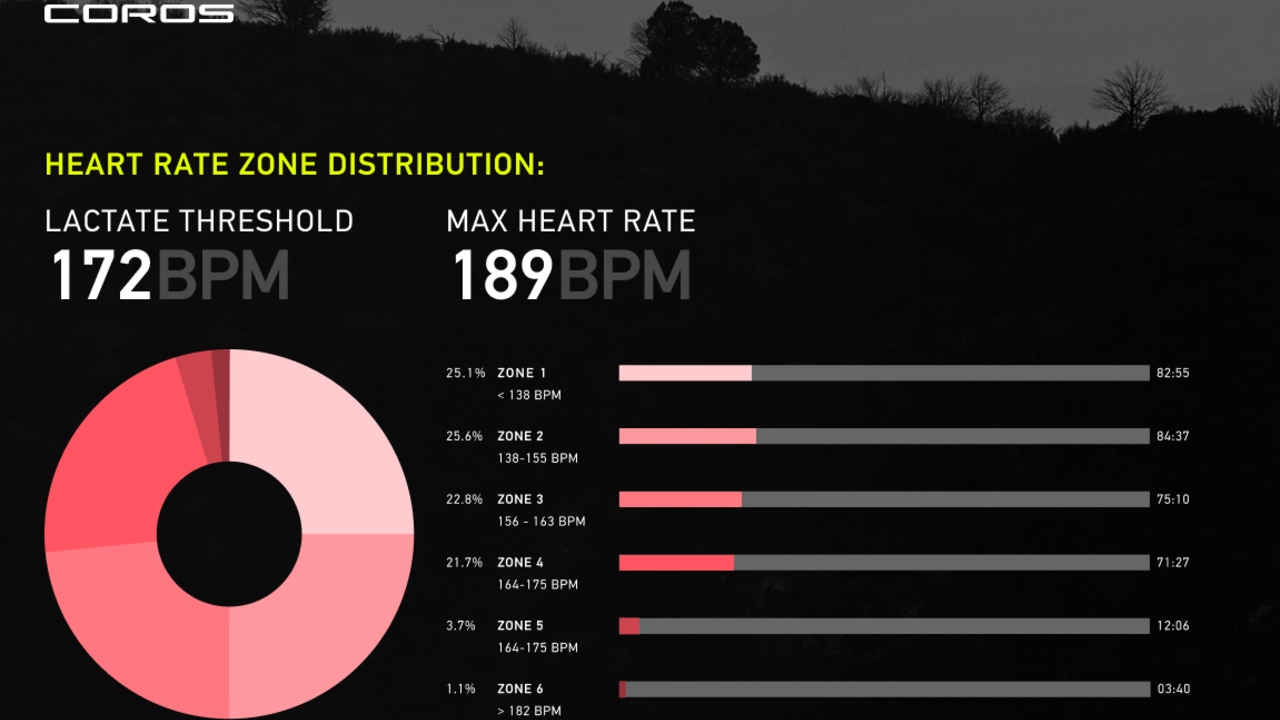
At elite ultra level, that balance is unusual.
But when combined with her carefully managed recovery structure, the picture starts to make sense.
Entrekin was not training for survival pace. She was training to run fast for extraordinarily long periods of time.
One workout from February offered a perfect example.
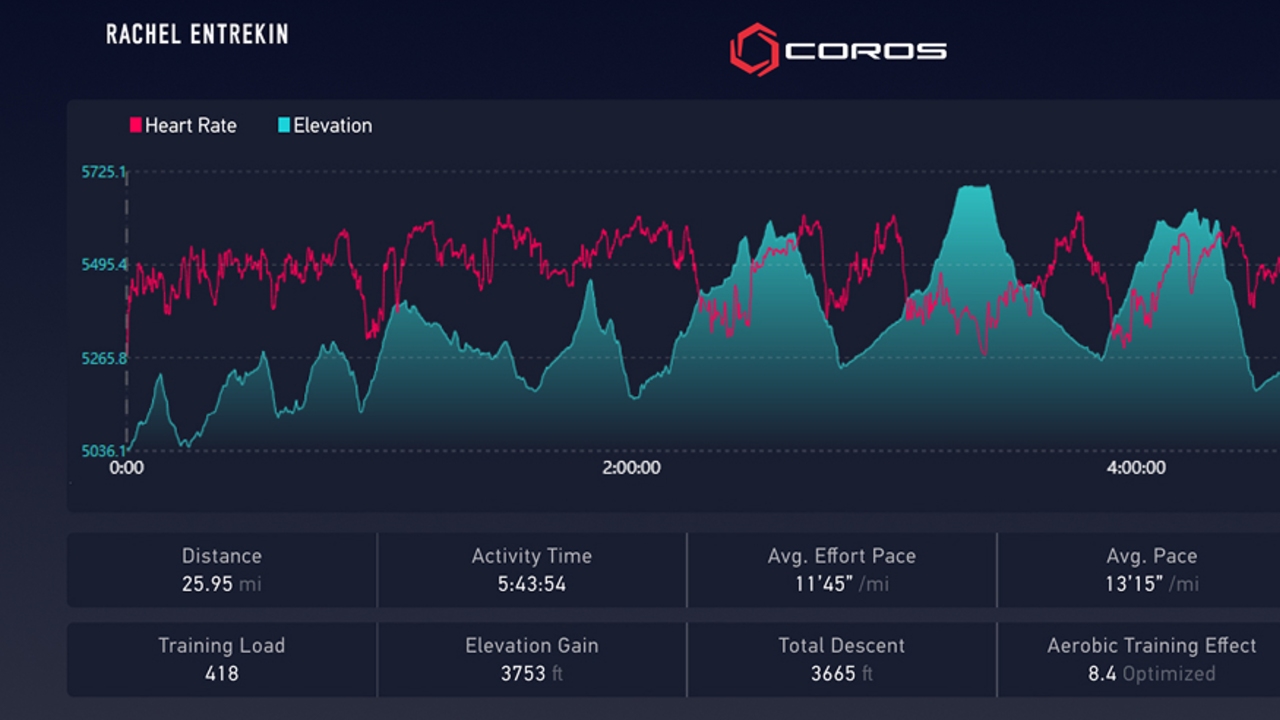
During a five-hour training run featuring 3,753 feet of climbing, Entrekin averaged 147 beats per minute while running 13:15 per mile terrain. But the key detail came on the descents.
While many ultrarunners use downhill sections to recover, Entrekin did the opposite.
She attacked them.
On multiple descents her heart rate climbed beyond 170 beats per minute as she aggressively trained the exact eccentric muscular load that would define the later stages of Cocodona.
The strategy became one of the defining themes of her race.
Conserve energy climbing. Push when gravity takes over – just look at the graphic below.
And if you’d like to take a closer look at the stage-by-stage detail and figures from Rachel’s actual race at Cocodona then click here.

Fueling 56 hours of effort
Training alone was never going to be enough.
The other major evolution in Entrekin’s approach came through nutrition and hydration with support from Precision Fuel & Hydration.
Her previous race at Chianti two months earlier had highlighted one major area for improvement: carbohydrate loading.
So ahead of Cocodona, Entrekin implemented her most disciplined pre-race fueling plan yet.
The day before the race she consumed approximately 7.7 grams of carbohydrate per kilogram of bodyweight, narrowly missing the recommended 8g/kg target. On race morning she again recorded her highest ever pre-race carbohydrate intake.
The goal during the race itself was to target roughly 60g of carbohydrate per hour using a mix of PF 30 gels, chews, carbohydrate drink mix and carefully selected real foods handed off by crew members at aid stations.
Mashed potatoes. Broth. Oatmeal. Pretzels.
Over the full 56 hours, her intake averaged approximately 49g/h.
Early in the race, however, she exceeded 60g/h through the opening 75 miles – precisely the phase during which she built a substantial lead and ran roughly 90 minutes ahead of her previous course-record pace.
Her intake inevitably fluctuated later in the race as temperatures dropped and fatigue mounted.
The lowest point came during the second night when carbohydrate intake dipped to approximately 31g/h at mile 212 as freezing temperatures reduced both fluid consumption and gel tolerance.
But critically, the intake never collapsed entirely.
She consistently brought it back under control, eventually climbing to 54g/h again between miles 228 and 235 before maintaining approximately 40g/h over the final 19 miles.
Perhaps the most impressive statistic of all?
No significant gastrointestinal issues across 250 miles.
For an ultramarathon of this duration, that alone borders on extraordinary.
| Section | Duration | Time Window | Carbohydrates (g) | Fluid (ml) | Relative Sodium Concentration (mg/L) | Caffeine (mg/kg) |
|---|---|---|---|---|---|---|
| Start to Crown King | 6:47 | 5:00am – 11:47am | 70 | 717 | 834 | 0.00 |
| Crown King to Whiskey Row | 6:45 | 11:47am – 6:32pm | 64 | 590 | 1767 | 0.00 |
| Whiskey Row to Watson Lake | 0:53 | 6:32pm – 7:35pm | 56 | 629 | 534 | 0.00 |
| Watson Lake to Fain Ranch | 2:34 | 7:35pm – 10:09pm | 39 | 329 | 1673 | 0.00 |
| Fain Ranch to Mingus Mountain | 2:42 | 10:09pm – 12:51am | 48 | 231 | 1478 | 0.36 |
| Mingus Mountain to Jerome | 3:35 | 12:51am – 4:26am | 54 | 247 | 1961 | 0.40 |
| Jerome to Dead Horse | 1:45 | 4:26am – 6:11am | 72 | 262 | 1145 | 0.34 |
| Dead Horse to Sedona Posse Grounds | 5:36 | 6:11am – 11:47am | 51 | 401 | 1502 | 0.32 |
| Sedona Posse Grounds to Schnebly Hill | 4:26 | 11:47am – 4:13pm | 43 | 284 | 1168 | 0.38 |
| Schnebly Hill to Munds Park | 3:15 | 4:13pm – 7:28pm | 36 | 199 | 1957 | 0.00 |
| Munds Park to Fort Tuthill | 6:09 | 7:28pm – 1:27am | 35 | 139 | 1411 | 0.35 |
| Fort Tuthill to Walnut Canyon | 4:32 | 1:27am – 5:59am | 31 | 120 | 670 | 0.32 |
| Walnut Canyon to Wildcat Hill | 1:28 | 5:59am – 7:27am | 53 | 232 | 902 | 0.83 |
| Wildcat Hill to Finish | 5:42 | 7:27am – 1:09pm | 40 | 187 | 984 | 1.21 |
A hydration strategy built from experience
Entrekin’s hydration plan also reflected lessons learned from previous years on the course.
Conditions across Arizona proved cooler than anticipated, with temperatures dropping toward freezing overnight alongside rain and hail in sections of the race.
As a result, fluid intake remained relatively modest for much of the event.
Her highest intake came during the opening seven hours when temperatures climbed above 20°C and runners were required to carry up to four litres of fluid between aid stations.
Across the final 100 miles, intake never exceeded 250ml per hour.
On paper that may appear dangerously low. But relative intensity, cool temperatures and reduced sweat losses meant the strategy remained appropriate.
More importantly, Entrekin adjusted the sodium component of her hydration far more aggressively than in previous years.
Electrolyte capsules were added alongside plain water to avoid diluting sodium concentration early in the race. Combined with sodium from drink mix and salty foods such as broth and potatoes, the strategy allowed her intake to remain closely aligned with her sweat sodium concentration.
The result?
No cramping. No major hydration issues. And, according to Entrekin herself, constant urination throughout the race – one of the simplest indicators that the balance was working.
Her verdict on the hydration plan was concise:
“9/10 – I felt hydrated, did not cramp and was peeing a lot so I was happy with my strategy.”
The caffeine surprise
For many observers, the most unexpected statistic in the entire performance may be Entrekin’s caffeine intake.
Across nearly 56 hours of racing, she consumed only around 230mg in total.
That is less caffeine than many marathon runners take in a single race.
Rather than relying on massive doses, Entrekin used small amounts of cola at aid stations during overnight sections to maintain alertness while avoiding the spikes and crashes associated with heavier intake.
The strategy paired with three short “dirt naps” totalling just 19 minutes across the race.
Again, the theme was precision rather than excess.
Nothing unnecessary. Nothing wasted.
“Why not me?”
As the race entered its latter stages and the fatigue inevitably deepened, Entrekin leaned on two thoughts.
The first was improving her own second-half split from the previous year.
The second was a simple mantra:
Why not me?

By the time she reached Flagstaff, the impossible calculations from her spreadsheets no longer mattered.
The athlete who had once projected 61:50 had crossed the line in 56:09:48.
What Entrekin achieved at Cocodona cannot be reduced to a single variable. Not the training. Not the fueling. Not the pacing. Not the mindset.
It was the combination that mattered.
The durability to continue running fast while everyone else slowed. The confidence to attack the descents. The discipline to fuel consistently for more than two days. The restraint to recover properly in training. The willingness to refine every detail after each previous attempt.
This was not luck. And it was not accidental.
Rachel Entrekin built the engine for one of ultrarunning’s greatest performances.
Then she refused to let it quit.
[With thanks to Douglas Musson at COROS and Emily Arrell, Sports Scientist at Precision Fuel & Hydrationm who was also one of Rachel’s Cocodona 250 crew]
Also well worth a watch is the YouTube embed below which gives a brilliant insight into the race itself…