

Following the draws for the 2026 UTMB World Series Finals in Chamonix between 24-30 August everyone knows whether they are in or out for the biggest races in the ultrarunning calendar.
And UTMB have now released all the data – which shows how things are trendig in terms of overall demand, female participation and reducing the event’s carbon footprint.
Here are some of the key findings…
Growing demand – but no more spaces
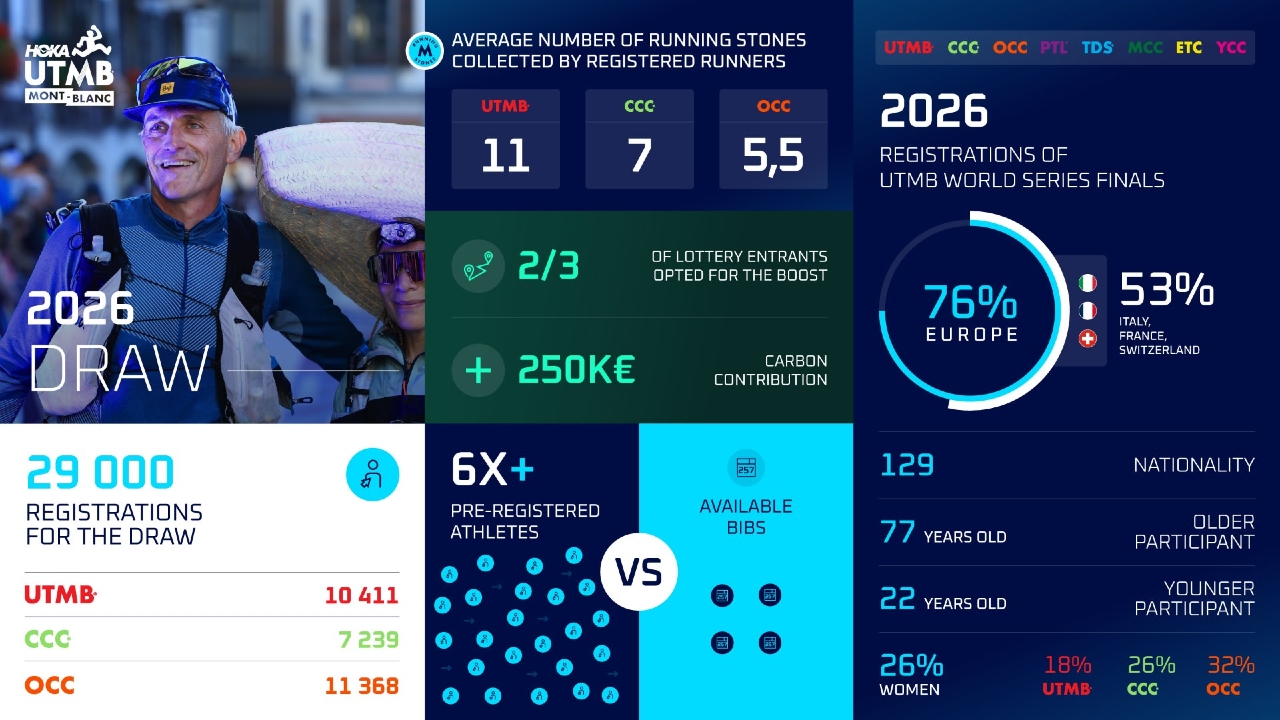
29,000 applications were registered for the UTMB World Series Finals draw, confirming ever-growing enthusiasm. Demand rose across all races, with pre-registrations up 16% for the UTMB (nearly 10,400), 14% for the CCC (nearly 7,200) and 16% for the OCC (nearly 11,400) compared with 2025.
But the organisers have maintained the same number of race bibs since 2006 “in order to preserve the landscapes and communities along the course and safeguard the quality of the runner experience”.
Isabelle Viseux-Poletti, UTMB France Director, explained: “Each year, HOKA UTMB Mont-Blanc inspires the same dream among thousands of runners around the world, and we are proud to see so many passionate athletes wishing to join the adventure. The draw unfortunately leaves many runners without a bib, and we recognise how legitimate that disappointment is, given the time, energy and hope invested.
“We sincerely regret this. For regulatory reasons and out of responsibility towards runners, volunteers and the region, the number of race bibs must remain strictly limited and cannot be increased. To those not selected, we extend our support and consideration, with the hope of welcoming them very soon to one of our start lines.”
Reducing the carbon footprint
This year an encouraging two-thirds of runners registered for the draws selected the “boost” in chances which came with committing to travel to the Mont-Blanc valleys via a lower-carbon route, without using a car.
Introduced as part of the HOKA UTMB Mont-Blanc Responsible Mobility Policy, this mechanism granted eligible participants a 30% increase in their chances in the draw.
UTMB said: “The figure signals strong community support for an approach designed to encourage more sustainable travel and reduce the event’s carbon footprint by 20% by 2030.”
They put a figure of €250,000 on it, adding: “This amount reflects the collective carbon contribution generated by runners, corresponding to emissions for their return journey between home and the event. All participants contributed as part of the HOKA UTMB Mont-Blanc Responsible Mobility Policy.
“This contribution will be complemented by those of the organisation, non-running partners and exhibitors, in order to cover the majority of the event’s emissions. All funds collected are channelled in full through an independent body responsible for identifying and auditing projects, ensuring their quality and impact.”
Female participation
Overall, women account for 26% of the field, with UTMB says this reflects “steady progress in female participation across all race formats”.
Equally there’s clearly a long, long way to go. Though credit where it’s due, the recent Tarawera Ultra-Trail by UTMB in New Zealand saw a 50:50 gender split, the first time an equal number of women and men lined up at a UTMB World Series event.
The 2026 edition of UTMB also marks a first with the integration of the MCC and ETC into the draw, a decision that has met with strong uptake. The TDS once again confirmed its appeal, with race bibs allocated within just a few hours, demonstrating sustained enthusiasm across the programme. Finally, the YCC highlights the growing interest of young runners in the UTMB universe.
- One of the biggest talking points around UTMB is how many stones you are likely to need to get into the race of your choice. There’s a clue in that it’s called a “lottery” but equally the figures are interesting and we’ll focus on that in much more detail next week.