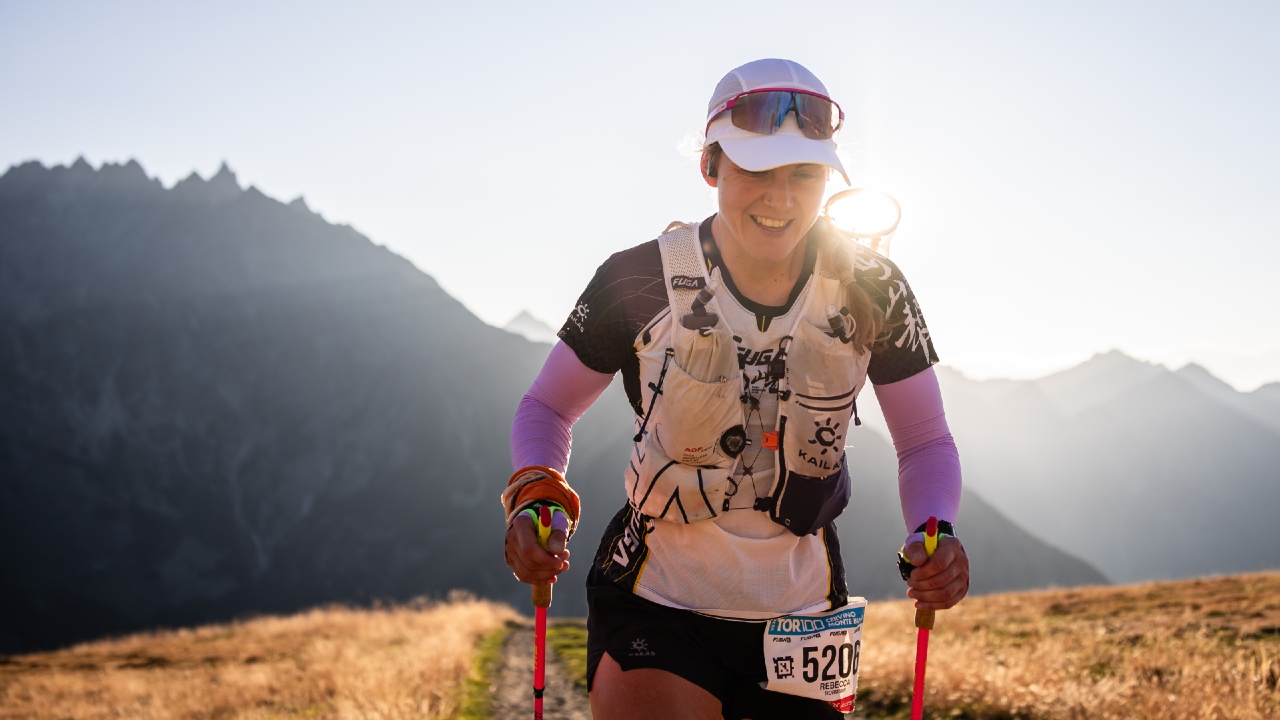
Walking during a trail run is sometimes treated as a sign that an athlete is struggling, but experienced trail runners know that this is not necessarily true. When a hill becomes sufficiently steep, walking can be an efficient way to continue climbing without spending considerably more energy for only a small increase in speed. The best choice depends on the gradient, terrain, race distance, your fitness and how much climbing remains. A short hill during a 10K may be worth running, while the same gradient deep into an ultramarathon may be better approached with a strong, purposeful walk. Learning when to change from running to walking is therefore an important trail skill. The goal is not to run every metre. It is to move across the entire course as efficiently as possible.
In Short
- Run moderate climbs when the effort remains sustainable.
- Walk when the hill becomes too steep to run efficiently.
- Consider the total race distance and remaining elevation.
- Use effort rather than pace to judge steep climbs.
- Practise purposeful uphill walking during training.
Why Does Gradient Change Running Efficiency?
As a trail becomes steeper, maintaining running mechanics requires progressively more energy. Your speed naturally decreases while the demands on your calves, quadriceps and glutes increase. Eventually, you can reach a point where running provides only a small speed advantage over walking while requiring substantially greater effort. That point differs between runners. Your decision should therefore be based less on whether a hill looks runnable and more on whether running it is useful within the context of the entire session or race.
When Should You Run Uphill?
Running generally makes sense when you can maintain a controlled effort without dramatically changing your movement.
Moderate gradients may allow you to:
- Keep a smooth rhythm.
- Maintain controlled breathing.
- Use a short natural stride.
- Continue running without excessive muscular strain.
Short climbs can also be worth running when you know there is an immediate descent or easier section afterward. The important question is not simply “Can I run this?” but “Can I run this without compromising what comes next?”
When Should You Walk a Steep Hill?
Walking becomes increasingly useful when your running pace has slowed to approximately the speed of purposeful walking but your effort remains much higher.
Consider walking when:
- The gradient becomes very steep.
- Your running form begins breaking down.
- Your breathing becomes disproportionately hard.
- The terrain makes running inefficient.
- You have many hours of racing remaining.
- Your legs are accumulating excessive fatigue.
Walking earlier can sometimes prevent you from being forced to walk later on terrain that would normally be easy to run.
Walking Is Not the Same as Stopping
There is an important difference between casually walking because you are exhausted and deliberately using a strong hiking technique. Purposeful uphill walking can maintain considerable forward momentum.
Keep:
- Steps short and consistent.
- Your body moving continuously.
- Your posture appropriate for the gradient.
- Your breathing controlled.
- Your attention on the terrain ahead.
The objective is still efficient forward movement.
Use Effort Rather Than Pace
Pace becomes much less useful on steep trails. A kilometre containing a significant climb may take considerably longer than a flat kilometre even when your effort is much higher. Trying to maintain your normal running pace can lead to an unsustainable increase in intensity. This is one reason should you train by time or distance for trail running becomes particularly relevant on routes where elevation and technical terrain make pace inconsistent. Judge climbs primarily according to effort and terrain.
Shorten Your Stride When Running Uphill
Trying to maintain your flat running stride on a steep hill usually requires too much force.
Instead:
- Shorten your steps.
- Maintain a comfortable rhythm.
- Keep your feet landing underneath you.
- Avoid excessive bouncing.
- Let pace decrease naturally.
A shorter stride can help you maintain momentum without turning every step into a large muscular effort.
Do Not Lean From the Waist
Some forward inclination is natural when climbing, but collapsing excessively at the waist can interfere with efficient movement. Try to maintain a relatively strong line through your torso while adapting naturally to the slope. Good posture also gives your arms room to contribute. The principles in how does posture affect running performance can help you understand why efficient alignment matters even when trail gradient constantly changes your running position.
Use Your Arms
Your arms can help maintain rhythm during uphill running. As the gradient increases, arm movement may naturally become more pronounced. Keep the shoulders relaxed and allow your arms to move in coordination with your legs. During running, how do arm swings improve running form explains how the upper body contributes to balance and rhythm rather than simply moving passively alongside the legs.
How Should You Walk Steep Climbs?
A strong uphill walk should be deliberate. Use short steps and maintain a consistent rhythm rather than taking large lunging strides. On very steep terrain, some runners place their hands above their knees or on their thighs to assist the climbing motion. This can help distribute some of the workload through the upper body.
Whether this technique is useful depends on the gradient and terrain.
Practise Walking Before Race Day
If your target race contains steep climbs, walking should be part of training. Athletes who never practice it can be surprisingly inefficient when they eventually need to walk during a race.
Training purposeful hiking helps you learn:
- Appropriate stride length.
- Sustainable effort.
- Transition timing.
- Posture.
- Climbing rhythm.
Practise on terrain similar to what you expect during competition.
Train the Specific Elevation Demands
Trail race difficulty cannot be understood from distance alone. A 20km race with little elevation may require very different preparation from a 20km race containing several long climbs. Study the expected elevation profile and train accordingly. Understanding how does elevation gain improve trail running performance can help you incorporate climbing progressively instead of suddenly adding enormous amounts of vertical training shortly before a race.
Build Uphill Strength
Climbing requires significant force from the lower body.
Important areas include:
- Glutes.
- Quadriceps.
- Calves.
- Hamstrings.
Hill running itself provides useful specific training, while strength exercises can complement it. Exercises such as step ups, split squats, calf raises and lunges can help develop the strength needed for repeated climbing.
Use Hill Workouts Carefully
Hill repetitions can improve fitness, strength and climbing confidence, but they also create considerable training stress. A useful session might involve several controlled uphill repetitions followed by easy recovery. The exact number and duration should match your experience. Avoid making every hill session a maximum effort. What mistakes should you avoid during hill workouts is particularly relevant when increasing climbing because excessive intensity can compromise both technique and recovery.
Race Distance Changes the Decision
The shorter the race, the more aggressively you may be able to approach climbs.
During a short trail race, running a steep hill may be worthwhile because:
- Total race duration is shorter.
- You can tolerate higher intensity.
- There may be fewer climbs remaining.
During an ultra, energy conservation becomes much more important. A hill you would run during a 10K might sensibly be walked during a 50 mile race.
Think About the Whole Course
Never judge one climb in isolation.
Before deciding how aggressively to climb, consider:
- How far you have already travelled.
- How much distance remains.
- How much elevation remains.
- What terrain follows the climb.
- Weather conditions.
- Your current effort.
Spending enormous energy gaining a few seconds early can cost minutes later.
Avoid Racing Other People Up Every Hill
Trail races naturally spread and regroup on climbs. A runner may pass you aggressively uphill, creating the temptation to follow. Let them go if their effort does not match your strategy. They may have different strengths, fitness or pacing plans. Your objective is to manage your own energy across the complete course.
Walking Can Protect Your Running
One of the strongest arguments for strategic walking is that it can preserve your ability to run the sections that are genuinely runnable. Suppose running a very steep climb only makes you slightly faster than walking but causes substantial fatigue. You may then lose more time on the following flat or descent because your legs are exhausted.
A purposeful walk can sometimes produce a faster overall result.
Learn to Transition Before You Are Exhausted
Do not wait until you are barely moving before switching to walking. Make the decision deliberately.
When running becomes inefficient:
- Transition into a purposeful walk.
- Establish a strong rhythm.
- Control your breathing.
- Monitor the gradient.
- Resume running when it becomes efficient again.
This creates a much smoother transition than repeatedly running, stopping and restarting.
Resume Running When the Gradient Eases
Some runners continue walking after the steepest part has finished because they have mentally settled into walking mode. Look ahead. As soon as the terrain becomes runnable and your effort is under control, gradually transition back into running. Practicing this during training makes the change more automatic during races.
Do Not Sprint Immediately After the Climb
Reaching the top can create an urge to accelerate. Your heart rate and breathing may still be elevated, particularly after a long climb. Give yourself a short period to settle into the next section.
If the course immediately descends, regain control before trying to increase speed.
Downhill Ability Matters Too
Efficient climbing provides limited benefit if you lose large amounts of time or energy on every descent. Downhill running requires its own combination of confidence, technique and strength. The guide how can trail runners run downhill faster without losing control can help you develop the ability to use descents effectively after completing demanding climbs.
Technical Terrain Can Change the Decision
Gradient is not the only reason to walk.
A section may be technically difficult because of:
- Loose rocks.
- Roots.
- Mud.
- Large steps.
- Poor footing.
Running may provide little advantage when every step requires careful placement. Slow down enough to move safely and efficiently. The fastest approach is not always the one with the fastest individual steps.
Fatigue Changes What Is Runnable
A climb that feels comfortable early in a race may become inefficient later.
As fatigue accumulates, your:
- Stride may shorten.
- Force production may decline.
- Balance may worsen.
- Heart rate response may change.
Your run or walk decision should therefore remain flexible. Do not follow a rigid rule such as “I always run this gradient.”
Fuel Before Long Climbs
Long climbs can make eating and drinking more difficult because breathing and effort increase. If you know a substantial ascent is approaching, consider your nutrition before reaching the steepest section. Long trail events require consistent energy intake rather than waiting until exhaustion develops. The principles in how to fuel for a trail run can help you plan carbohydrate and fluid intake around the changing demands of the course.
Heat Can Make Walking More Valuable
Hot conditions increase cardiovascular strain. A hill that is normally sustainable at a run may require a much greater effort in heat. Adjust your strategy accordingly. Walking selected climbs can help control effort and reduce unnecessary heat production, particularly during longer races.
Build Endurance Before Chasing Climbing Speed
Strong climbing requires more than powerful legs. You need enough endurance to repeat climbs without major deterioration. Regular aerobic training helps establish that foundation. What is the best way to train for long trail runs can help you develop the durability needed to maintain useful climbing effort deeper into longer events.
Train Both Running and Walking
If your race includes significant steep terrain, your training should include both skills.
You might practise:
- Running moderate gradients.
- Walking steep gradients.
- Changing between the two.
- Running after long climbs.
- Hiking when already fatigued.
This makes race day decisions familiar rather than improvised.
Use Training to Find Your Own Transition Point
There is no universal gradient at which every runner should start walking. Fitness, body size, technique, terrain and race duration all influence the decision. During training, compare running and walking on steep climbs.
Notice:
- Speed difference.
- Heart rate.
- Breathing.
- Leg fatigue.
- How quickly you recover afterward.
Over time, you will develop a better sense of when running remains worthwhile.
Do Not Judge Success by How Much You Walked
A trail runner who walks strategically can finish faster than someone who insists on running every hill. Race performance is determined by the complete course.
Evaluate whether your strategy helped you:
- Maintain energy.
- Run later sections strongly.
- Avoid major slowdowns.
- Finish efficiently.
Walking percentage alone tells you very little.
Common Mistakes
- Trying to run every climb.
- Waiting until exhaustion before walking.
- Taking excessively long steps uphill.
- Chasing other runners on climbs.
- Ignoring the remaining elevation.
- Never practising purposeful walking.
- Continuing to walk after terrain becomes runnable.
- Treating pace as the main measure of uphill effort.
Practical Tips
- Shorten your stride when climbing.
- Run when effort remains sustainable.
- Walk steep sections purposefully.
- Practise transitions during training.
- Train on race specific elevation.
- Control your effort early in long races.
- Resume running when the gradient eases.
- Judge your strategy across the whole course.
Actionable Takeaways
You do not need to run every steep hill to be a strong trail runner. As gradient increases, there comes a point where running requires much more energy while providing very little additional speed. Purposeful walking can then become the more efficient choice.
Use training to learn where that transition occurs for you. Practise running moderate climbs, walking steep ones and smoothly changing between the two. Your decision should also reflect race distance, terrain, weather, remaining elevation and your current level of fatigue.
Most importantly, judge your climbing strategy by what happens afterward. If walking a difficult climb allows you to run strongly across the next several kilometres, it may be faster than forcing yourself to run every metre.
FAQs
Run when you can maintain an efficient and sustainable effort. When the gradient becomes steep enough that running requires much more energy for little additional speed, purposeful walking may be more efficient.
No. Strategic walking is common in trail running, particularly on steep climbs and during longer races.
There is no universal gradient. Your fitness, terrain, race distance, fatigue and relative running and walking speeds all influence when walking becomes more efficient.
On sufficiently steep terrain, purposeful walking can require less energy while producing a speed relatively close to slow uphill running.
Walking selected climbs can be an effective pacing strategy in ultramarathons, especially when conserving energy allows you to continue running easier terrain later.
Use short purposeful steps, maintain a steady rhythm and avoid unnecessary pauses. On very steep terrain, some runners also use their hands on their thighs for additional support.
Shorten your stride, allow pace to decrease, keep your breathing controlled and avoid trying to maintain flat ground speed.
Yes, particularly if your target event contains steep climbing. Purposeful hiking is a skill and becomes more efficient with practice.
Resume running when the gradient becomes runnable and your effort is controlled. Practicing this transition can prevent unnecessary walking after the steep section has ended.
Yes. If walking saves enough energy to maintain stronger running later, it can contribute to a faster overall race even though you temporarily move more slowly on the climb.